A minimalist bullet journal comes down to five pages: an index, a future log, a monthly log, a daily log and collections. That’s the whole system Ryder Carroll designed, before the hand-lettered headers, washi tape and weekly spreads that fill Pinterest. If you’ve started a bullet journal and dropped it because the setup took longer than the planning, going back to those five pages is usually the fix.
Here’s what each page does, how to keep it simple, and what we’d skip.
Why a minimalist bullet journal sticks
The bullet journal method was built to be fast. You write short lines, mark each one as a task, an event or a note, and move on. It only gets slow when the journal turns into an art project, and then a missed week feels like a failure because the spreads are half drawn.
A minimal setup avoids that. There’s nothing to draw ahead of time, so you can open the notebook on a busy Monday and start writing straight away. If you skip a few days, nothing breaks. You start a new daily log and carry on.
The five pages you actually need
1. Index
The index is your table of contents. Each time you start a new page, like a monthly log or a book list, you write its name and page number here. It’s what lets you find anything again months later. On paper, you number the pages yourself. In a hyperlinked PDF, the index rows already link to the pages, so you only write the label.
2. Future log
The future log holds anything that happens after this month: a dentist appointment in March, a birthday in June, a deadline next quarter. Split one or two pages into six or twelve boxes, one per month, and write dates in the right box. When a new month starts, you check its box and copy what’s there into the monthly log.
3. Monthly log
The monthly log is two pages. On the first, list the days of the month down the side and note events next to each date. On the second, list the tasks you want to get done this month. That’s it: no colors, no themes. It takes five minutes at the start of each month.
4. Daily log
This is where most of your writing happens. Write the date, then log the day as it goes with short bullets. Don’t plan the space in advance. If today needs half a page and tomorrow needs two, that’s fine. A new day starts wherever the last one ended.
5. Collections
Collections are pages for one topic: books to read, gift ideas, notes for a project. Start one whenever a topic keeps coming up in your daily log, give it a title, and add it to the index. Leave a page or two blank after it if you think it’ll grow.
The bullets: three marks and two arrows
Rapid logging is the habit that makes the whole thing fast. Every line starts with a mark that tells you what it is:
- A dot for a task. Turn it into an X when it’s done.
- A circle for an event, something that happens on a date.
- A dash for a note, a thought or something you want to remember.
- A right arrow (>) on a task you’ve moved to a later page.
- A left arrow (<) on a task you’ve scheduled into the future log.
That’s the full key. You don’t need a legend page, color codes or extra symbols. If you want one more, add a star for anything important, but most people find the basic marks are enough.
What a minimal daily log looks like
Here’s a made-up Tuesday, written the way you’d actually log it. The date goes at the top, then lines get added through the day as things come up:
- X Email Sam the budget numbers
- O Team call, 10:00
- • Book the car service
- – Sam wants the report by Friday, not Thursday
- > Draft the newsletter (moved to tomorrow)
- – Idea: a reading list for the team
Six lines, and the whole day is there: one task done, one event, one task still open, a note, one task pushed to tomorrow and an idea worth keeping. If that idea keeps coming back, it becomes a collection page with its own line in the index. Nothing here needed planning ahead, and nothing took longer than writing the words. That’s what keeps a minimal journal going on the busy days, which are the days you need it most.
Migration keeps it short
At the end of each month, look back at every open task. For each one, decide: is it still worth doing? If yes, move it to the new monthly log and mark the old one with an arrow. If not, cross it out. Rewriting a task by hand makes you think twice about it, and a lot of tasks don’t survive the second look. That’s the point. Migration is what stops a minimal journal from turning into an endless list.
What to skip
Most of what makes bullet journals look complicated is optional. If you’re going minimal, skip these until you miss them:
- Weekly spreads. The daily log already covers the week. Add a weekly page later only if you find yourself wanting one.
- Decorated headers and themes. A plain date is enough.
- Lots of trackers. Pick one habit you actually care about, not ten.
- Pre-drawn pages for the whole year. Set up each month when it starts, not all at once.
A minimal bullet journal on an e-ink tablet
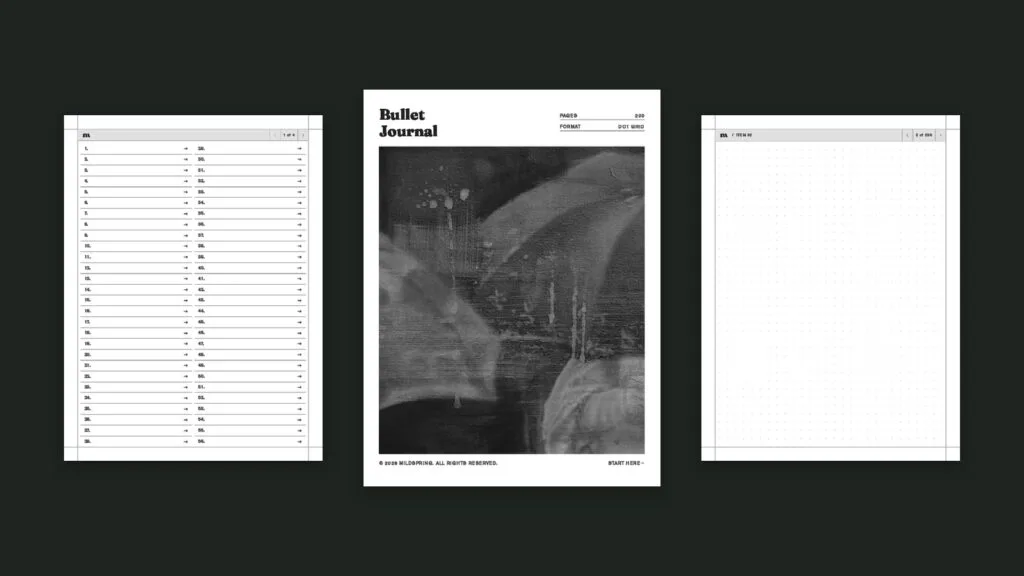
The method doesn’t need paper. On an e-ink tablet like a reMarkable, Kindle Scribe, Supernote or BOOX, you keep the same five pages and the same handwriting, and you lose the two chores that wear people down on paper: numbering pages and keeping the index up to date. A hyperlinked bullet journal PDF has links built in, so you tap an index row to jump to that page and tap again to get back.
Dot grid pages suit the minimal style best. The dots give you enough structure to keep lines straight and boxes even, without the visual noise of full grid lines. If you’re unsure, our guide to the best page style for bullet journaling compares the options.
Questions
What pages do I need in a minimalist bullet journal?
Five: an index, a future log, a monthly log, a daily log and collections. Everything else is optional.
Do I need a weekly spread?
No. The original method uses daily logs, which already cover the week. Add a weekly page only if your week needs a bird’s-eye view.
How long does a minimal setup take?
A few minutes to start: an index page and a future log. After that, about five minutes at the start of each month for the monthly log.
Want the five pages without the setup? Our Bullet Journal is a hyperlinked PDF with 200 undated dot grid pages and a linked Notes index, sized for reMarkable, Kindle Scribe, Supernote and BOOX. You draw your own logs and collections, and the index takes you straight to each one. For the method itself, see Ryder Carroll’s official Bullet Journal site.