To learn how to solve a nonogram, start with one idea: the numbers beside each row and above each column tell you how many filled squares sit together in that line, in order, with at least one blank square between each group. You fill in squares only when the clues prove they must be filled, mark the ones that must stay blank, and keep switching between rows and columns until a picture appears. No guessing needed on a well-made puzzle. Below are the rules, the five moves that solve most puzzles, and what to do when you get stuck.
What is a nonogram?
A nonogram is a picture logic puzzle on a grid. Every row and every column has a clue made of one or more numbers. When you’ve filled in all the right squares, they make a simple black-and-white picture.
The puzzles come from Japan. Non Ishida, a graphics editor, came up with the idea in 1987, and puzzle maker Tetsuya Nishio invented the same kind of puzzle on his own around the same time. Ishida first published hers in 1988 as “Window Art Puzzles.” The English name was coined by UK puzzle collector James Dalgety, who joined “Non” from her name with “gram.” You’ll also see them called Hanjie, Paint by Numbers, Griddlers, Pic-a-Pix and Picross.
How to read the clues
A clue lists the groups of filled squares in that line, in order from left to right (for rows) or top to bottom (for columns). A row clue of “3 1” means somewhere in that row there’s a group of three filled squares, then at least one blank, then a single filled square. The clue doesn’t tell you where the groups start, only their sizes and their order.
Two notation habits make everything easier:
- Fill a square when you know it’s part of the picture.
- Mark an X in a square when you know it must stay blank. Blanks are clues too. Most stuck moments come from forgetting to mark them.
How to solve a nonogram, step by step
These five moves solve most puzzles from easy to medium. Work through them in order on a new puzzle, then keep cycling through them as the grid fills in.
1. Fill the lines that only fit one way
Add up the clue numbers, then add one for each gap between groups. If the total equals the length of the line, there’s only one way to place them. In a 10-square row, “4 5” adds up to 4 + 1 + 5 = 10, so the row is four filled, one blank, five filled. A clue of 0 means the whole line is blank, so X it out.
2. Use the overlap for big groups
This is the move that does the most work. Picture the group pushed as far left as it can go, then as far right. Any squares covered in both positions must be filled. In a 10-square row with a clue of 8, pushed left it covers squares 1 to 8, pushed right it covers 3 to 10. Squares 3 to 8 are in both, so fill all six.
A quick rule for a single number: if the group is more than half the line, the overlap is the group size times two, minus the line length, right in the middle. For an 8 in a row of 10, that’s 8 × 2 − 10 = 6 squares. With several numbers, do the same thing with all the groups packed to the left and then to the right, and compare each group with itself.
3. Mark the squares nothing can reach
Once some squares are filled, look at where each group could still go. If a row’s clue is a single 3 and you’ve filled square 5, the group must include square 5, so it can only cover squares 3 to 7 at most. Every square outside that range is blank: mark them all with an X. When a line’s groups are all complete, X every remaining square in it.
4. Grow groups from the edges
A filled square on the edge of the grid is a gift. If the first square of a row is filled and the row’s first clue is 3, that group must start right there: fill squares 1 to 3 and put an X in square 4. The same works next to an X you’ve already marked, because a blank acts like a wall the group can’t cross.
5. Switch between rows and columns
Every square you fill or X in a row is new information for the column it sits in, and the other way around. After a pass through the rows, go through the columns, then back to the rows. Most puzzles fall apart after a few rounds. If a pass changes nothing, look for a line where a group is now partly placed and try moves 2 to 4 on it again.
When you get stuck
Bigger puzzles sometimes need a deeper look. Before you guess, try these:
- Check your X marks. A blank you forgot to mark is the most common reason a puzzle seems stuck.
- Count again. Compare each finished line against its clue. One miscounted square can block a whole area.
- Look at the biggest number left. Big groups have the least room to move, so they usually give the next move.
- Test one square. On hard puzzles, assume a square is filled and follow the logic. If it leads to a line that breaks its clue, the square must be blank. Do this lightly, in your head or in pencil, so you can undo it.
Good puzzles are built so you never have to guess. If you’re truly stuck, the answer is almost always one of the four moves above, waiting in a line you haven’t looked at in a while.
Solving nonograms on an e-ink tablet
Nonograms work well on a reMarkable, Kindle Scribe, Supernote or BOOX. The grid is black and white, the pen fills squares quickly, and you can erase a mistake without wearing a hole in the paper. A few habits help:
- Use a thick pen for fills and a thin one for X marks, so blanks don’t look like filled squares at a glance.
- Zoom in on big grids if the squares feel small, then zoom back out to see the picture forming.
- Start small. An 8 by 8 grid teaches the moves in a few minutes. Move to 10 by 10 and 12 by 12 once the overlap rule feels natural.
Questions
Do you have to guess to solve a nonogram?
Not on a well-made puzzle, and that’s the fun of learning how to solve a nonogram properly. Easy and medium puzzles fall to the overlap, blank-marking and edge moves. Hard ones may need you to test a square and look for a contradiction, which is still logic, not guessing.
Where should I start a nonogram?
With the lines whose clues fill them completely or nearly completely, then with the biggest numbers, using the overlap rule. Small numbers in long lines usually come last.
What’s the difference between a nonogram and Picross?
None, really. Picross is one of several names for the same puzzle, along with Hanjie, Griddlers, Pic-a-Pix and Paint by Numbers.
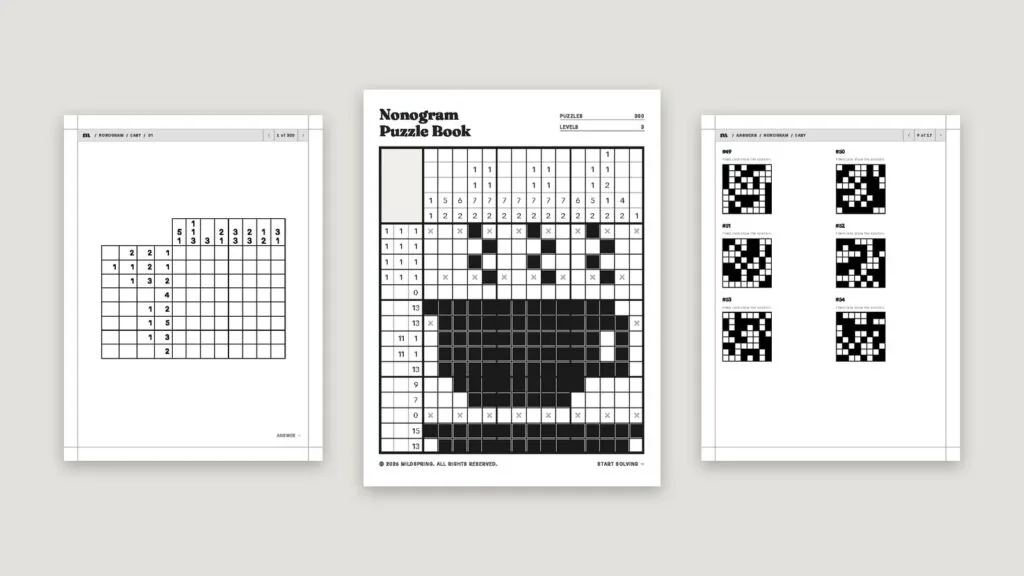
Ready to practice? Our Nonogram Puzzle Book has 300 puzzles at three levels, from 8 by 8 to 12 by 12, one per page, with every answer at the back. It’s a hyperlinked PDF sized for reMarkable, Kindle Scribe, Supernote, BOOX and more, so you can tap from the contents straight to any puzzle. For the history and the more advanced techniques, Wikipedia’s nonogram article is a good next read, and if you like number puzzles too, see our guide to sudoku on an e-ink tablet.