Multi-Section Notebook for Kindle Scribe
$14
One-time purchase, lifetime access.
Want different sections or page styles? Customize this notebook
Also available for
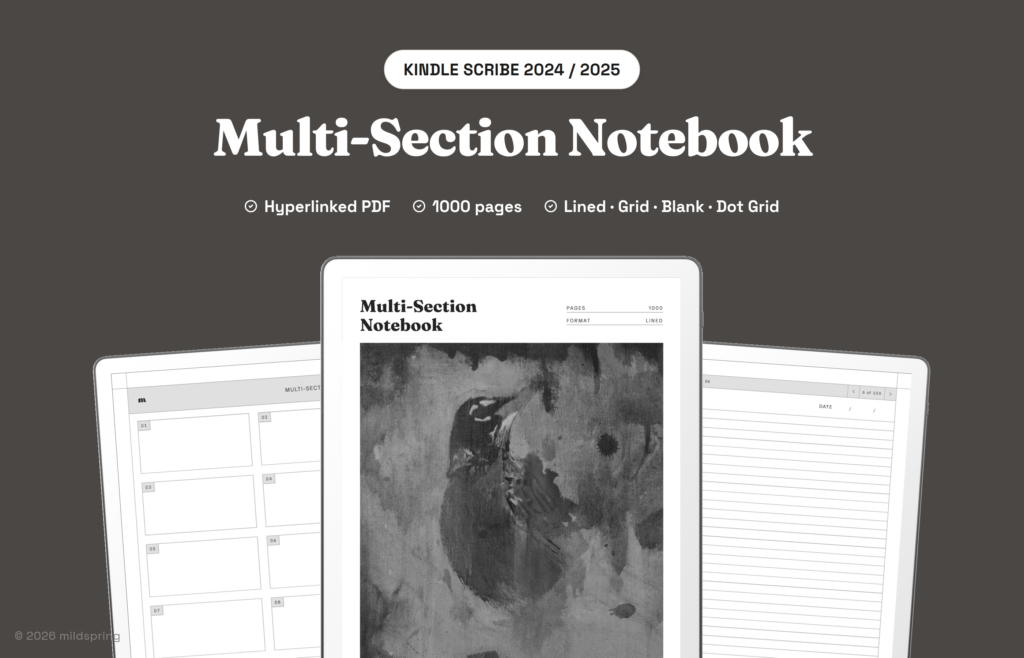
A hyperlinked PDF notebook for Kindle Scribe with 10 numbered sections and 1,000 writing pages. Four page styles included as separate PDFs: Lined, Blank, Dot Grid, and Grid.
The Multi-Section Notebook for Kindle Scribe is a hyperlinked PDF for people who keep several kinds of notes on one tablet and hate watching them pile into one library file. It is the multi section notebook kindle scribe owners use when daily notes, project drafts, meeting logs, and reading notes need their own rooms. You get 1,000 writing pages in ten sections of 100 pages each, and the section names start blank so you label them yourself.
Open the cover, tap into the collection index, and you see sections 01 through 10 as links. Each section has its own index of 100 rows. Tap a row and you land on that writing page. A breadcrumb at the top of every writing page sends you back to the section index or the collection index, so finding last Tuesday’s meeting notes does not mean flipping through someone else’s project pages.
The cover artwork was painted by Rabia, who hand-paints the cover of every mildspring product.
Checkout includes four separate PDFs, one for each page style, so you can keep a lined notebook and a blank notebook open as two different books on the same Scribe.
What is inside the multi section notebook kindle scribe
- 1,042 pages per file: one cover, one collection index, forty section index pages, and 1,000 writing pages.
- Ten sections of 100 pages. Section 01 covers its own hundred pages, section 02 the next hundred, and so on through section 10.
- A collection index that lists all ten sections as tappable links on one page.
- A four page index inside every section. Entries 1 to 28 sit on the first page, then 29 to 56, 57 to 84, and 85 to 100. Every row jumps to that writing page.
- Blank section labels you write in by hand, so the book matches how you actually work rather than a printed category list.
- A TITLE and DATE field on every writing page, plus a breadcrumb showing the section and page.
- No global page numbers stamped through the whole file. Each writing page shows its place inside the section, such as 37 of 100.
- Four page styles as four PDFs: Lined, Blank, Dot Grid, and Grid. Each one is a complete 1,000 page notebook in that style.
How the ten sections work
Kindle Scribe libraries fill up fast with half-finished notebooks. This file is the opposite approach: one PDF that behaves like ten notebooks sharing a front door. You name the sections once, then keep returning to the same streams instead of starting a new document every time a topic changes.
Inside a section, each index entry is one writing page. That is a deliberate choice. Our Classic Notebook gives five pages per entry for topics that run long. This Multi-Section layout is built for dated logs, short notes, and lists you want to retrieve by number, which is why the unit is one page with its own title and date field.
The pages never shuffle. Links point at fixed destinations, empty pages stay empty until you need them, and filling section 04 does not push section 05 around. When one section is full, move to another section or download a clean copy of the same ruling and start again.
How navigation works on the Scribe
Everything opens in the Kindle Scribe’s built-in PDF reader. There is no extra app to install and no account required for the links to work, because internal PDF links are ordinary document behaviour on the Scribe.
Tap a section on the collection index and you jump to that section’s index. Tap a numbered row and you land on the writing page. Tap the breadcrumb and you return up a level. Swipe and page-turn gestures still work if you prefer to move through a section in order.
The PDF also carries bookmarks for the cover, the collection index, and each section index, so the Scribe’s own navigation panel gives you a second way into the structure without hunting by page number. Keep the file as a PDF when you transfer it. A converted Kindle-format copy loses the fixed page layout and the tap links.
The four page styles
Lined is the tight ruling meant for text. It fits more lines on the 10.2 inch page than a standard paper notebook, which helps when you are writing with a stylus rather than a pen.
Dot Grid leaves the page quieter while still giving you points to line things up against. Use it when handwriting sits next to diagrams, tables, or bullet layouts.
Grid is the small square grid for schedules, budgets, rough scale sketches, and notes you want in columns.
Blank drops the ruling entirely and keeps the header, breadcrumb, and title fields. Drawing, mind maps, and free handwriting belong here.
They ship as four files rather than a style switcher inside one file, so you can load one, two, or all four onto the Scribe and treat each as its own notebook.
Made for the Kindle Scribe 2024
This version is sized for the Kindle Scribe (2024, 10.2 inch), the second generation model. The page is 157 by 210 millimetres, which is what that 1860 by 2480 pixel screen works out to at 300 ppi. The page fills the screen at native size, so nothing is scaled up, letterboxed, or cropped, and the ruling sits at the spacing we drew it at rather than whatever a fit-to-screen zoom decides.
That exact fit is also why we do not sell this file for the 2025 Kindle Scribe. The third generation moved to an 11 inch screen, so a page cut for the 10.2 inch model would be scaled to fit rather than matched to it. Colorsoft is a different panel again. If you are on either of those, wait for us rather than buying this one.
The same notebook is drawn for other screens too, so if you also use another tablet, look at the Supernote, reMarkable, and Quaderno versions, each cut to that device’s own page size.
Which of our Kindle notebooks to pick
We draw five notebooks for the Kindle Scribe, and they differ in how the pages are divided rather than in how they look. This Multi-Section file is the one for several named streams that should stay apart.
Pick this Multi-Section Notebook when work, study, and personal notes should not share one contents page. Ten blank-label sections with their own indexes are built for that split.
Pick the Classic Notebook when you want one long notebook with generous room per entry. A hundred entries at five pages each covers a year of most people’s note-taking, and it is the safer start if you are not sure you need ten streams.
Pick the Cornell Notes Digital Notebook when the page itself needs structure. Its 200 pages each carry a cue column, a notes block, and a summary band for lectures and reading you plan to revisit.
Pick the Business Meeting Notebook if most of your writing happens in meetings, since its 200 pages are laid out around attendees, agenda, notes, and action items.
Pick the Bullet Journal if you work in short logged entries. It is 200 dot grid pages set up for rapid logging.
They all share the same tap-to-jump navigation and the same 157 by 210 mm page, so the way you move around them feels consistent.
Getting it onto your Scribe
After checkout you get four downloads, one per page style. Save the ones you want on a computer first. They are a few megabytes each, and a local copy is useful if you ever need to re-import.
The most direct route is a USB-C cable. Plug the Scribe in, copy the PDFs into the documents folder, and eject. No Amazon account is required for that path. You can also use Send to Kindle. If you do, send the file as a PDF and do not let it convert to Kindle format, because the fixed page layout and the tap links are the whole point of the notebook and a converted file loses both.
Once the file is in your library it works offline like anything else on the Scribe, and your handwriting is saved into the document as you write.
What you get at checkout
One purchase at $14, four PDF downloads, and no subscription or expiry. The files are yours to keep and to re-download, and you can load them onto your own devices as many times as you need. If you fill a notebook, download a fresh copy and start again on a clean 1,000 writing pages.
Frequently asked questions
How many pages do I actually get?
Each file is 1,042 pages: a cover, a collection index, forty section index pages, and 1,000 writing pages. Four files come with the purchase, so 4,000 writing pages across the set.
How many files come with this?
Four PDFs in one purchase: Lined, Blank, Dot Grid, and Grid. Each is a full 1,000 page notebook in that style.
Which Kindle Scribe does this fit?
The 2024 Kindle Scribe, the 10.2 inch second generation model. The page is 157 by 210 mm to match that screen exactly. The 2025 third generation Scribe has an 11 inch screen and needs a different file, which we do not offer yet. Colorsoft is also not this file.
Are the sections already labeled?
No. The ten section names start blank so you can write your own labels. The indexes still number them 01 through 10 for linking.
Do the links really work on the Scribe?
Yes. Collection rows, section index rows, and breadcrumbs are standard PDF links, which the Scribe reader follows on a tap. Keep the file as a PDF when you transfer it.
How is this different from the Classic Notebook?
Classic is one long book with 100 entries at five pages each. This Multi-Section file splits 1,000 pages into ten named sections with their own indexes.
Can I use more than one page style at once?
Yes. They are four separate files, so each one you copy across shows up as its own notebook in your library.
Do I need an app or an internet connection?
Neither once the file is on the device. USB transfer needs no account, and after import the notebook works offline in the built-in reader.